A Pocket Field Guide to Noticing Local Stonework
Use this pocket field guide to noticing local stonework to compare streetside details, keep clear field notes, and see how local building styles differ.
Local stonework becomes easier to compare when you record how it meets the street, not just what its surface looks like. On a short walk, note whether a wall frames a shop entrance, holds a slope, marks a churchyard, or lines a market square. Those relationships show how stone helps shape a place’s everyday character.
A pocket notebook and pencil are enough. Choose a route with public viewpoints and pause where you will not block a doorway or sidewalk. Your notes can describe visible details without trying to identify a quarry, date a building, or explain how a wall was made.
What should you bring on a stonework walk?
Keep your kit simple: a notebook, pencil, and a map or hand-drawn route. A phone can help you note locations or photograph a view from a public path, provided photography is allowed. Do not enter private property, lean on a wall, or step into traffic to improve a view.
Before setting out, choose a route that passes several kinds of streetscape: perhaps a market square, a lane of shopfronts, and a boundary wall beside a public path. Check that each stopping place is accessible and leaves room for others to pass.
- Light: If a wall is mostly shaded or strongly sunlit, record that condition; then compare its color cautiously with surfaces seen in different light.
- Weather: If the stone is wet, note the rain; then describe its appearance without treating the darker color as a lasting feature.
- Viewpoint: If you can see the wall clearly from the public path, make a note or photograph; otherwise, skip it and choose a safe, unobstructed view.
- Access: If a route crosses a closed or private area, leave that section out; then use a nearby public street instead.
- Tools: If a notebook and pencil are easy to carry, use them; if not, record brief notes on your phone while standing clear of foot traffic.
- Uncertainty: If a detail is hard to read, write what obscures it; then leave the interpretation open rather than filling the gap with a guess.
It is not worth carrying a guide to every geological formation or trying to name each stone. That effort can distract from the more revealing question of how a wall sits within the street and how people encounter it.
How can you choose a route that invites comparison?
Pick a compact loop that lets you compare several walls without repeatedly crossing a busy road. Include different settings if they are nearby: a shopfront, a public building, a retaining wall, or a doorway surround. These are useful subjects because each has a distinct relationship to the street, not because its appearance settles how or when it was built.
At each stop, note what the wall does in its setting. Does it create a sheltered entrance, divide a public path from a garden, or hold back a change in ground level? Record nearby features such as a bench, sign, drain, or street corner when they help locate the view. These details make your notes about place rather than a catalog of surfaces.
What should you notice first at each stop?
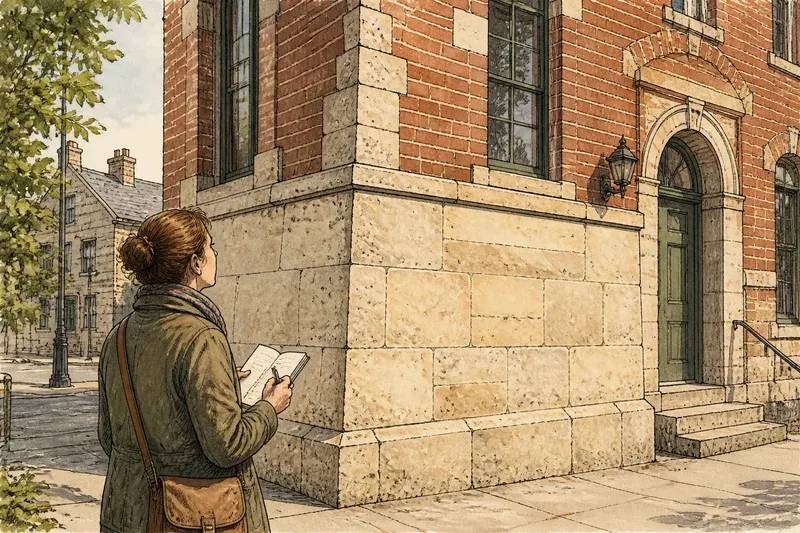
Use a steady sequence: setting, visible form, then surface. Begin with the wall’s role in the street. Then describe the outline of openings, corners, or changes in height. Finish with a few visible details of color, shape, or arrangement if they help distinguish this stop from another.
How does the wall shape the street?
Notice whether it creates a boundary, supports a slope, encloses a yard, or forms part of a building frontage. A low wall beside a path offers a different experience from a tall face along a narrow lane. Describe what a passerby can see and how the wall affects the route through the place.
Which features help you recognize the setting?
Look for visible relationships with doorways, windows, steps, signs, drains, and nearby public spaces. A wall beside a market entrance can be noted as part of that approach; a wall along a churchyard path can be recorded in relation to the path and gate. Keep the note concrete rather than assigning a history you cannot see.
What surface details are useful to record?
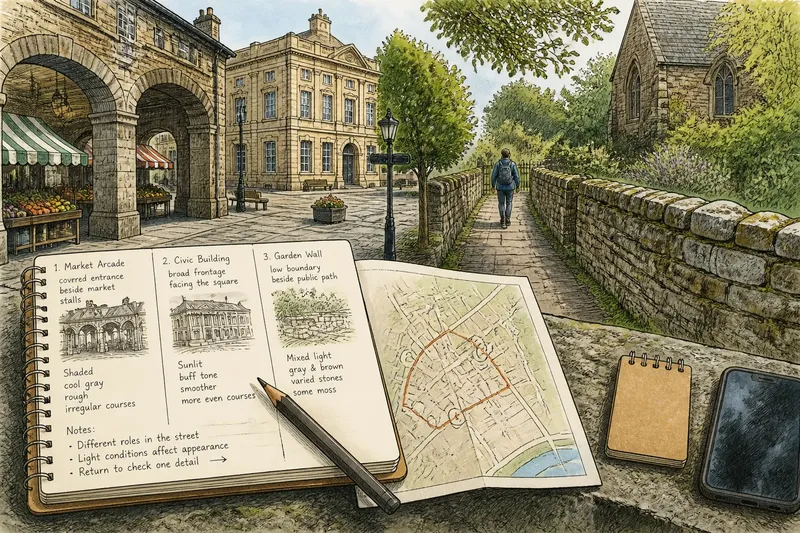
Use broad descriptions: cool gray, buff, cream, brown, or mixed; smooth-looking or rough; mostly even or visibly varied. You may also note whether the visible pieces seem similar in size, whether rows are apparent, or whether the arrangement changes around an opening. Treat these as descriptions of the view, not explanations of origin or construction.
How do you make the walk a useful routine?
Give the route a calm rhythm. Begin at a recognizable public landmark, pause at a few contrasting settings, and finish somewhere you can review your notes without obstructing anyone. If a stop feels unsafe or intrusive, skip it.
- Before leaving: Mark a short public loop and choose three stops, such as a shopfront, a boundary wall, and a civic building. If a route segment is closed or crowded, replace it with another public viewpoint.
- At the first stop: Write down the wall’s role in the street and one nearby feature that helps locate it. If the setting is unclear, note the uncertainty and move on rather than inventing a description.
- At the next stop: Record the same details, then note one difference in setting or form. If the views are too different to compare directly, keep the descriptions separate.
- At a third stop: Look at a corner, entrance, or change in height from the public path. If it is partly hidden, record what blocks the view and do not approach through a restricted area.
- At the end: Reread your notes and mark one detail to check on another visit. If nothing remains unclear, keep the route as a useful record rather than adding a question for its own sake.
Say you begin beside a shaded market arcade, then pass a sunlit public building and a low wall along a garden path. At the arcade, you write “covered entrance beside market stalls”; at the building, “broad frontage facing the square”; at the garden, “low boundary beside public path.” You then note that the arcade and building look darker and lighter, respectively, while marking their different light conditions. The resulting notes distinguish each setting without treating surface appearance as proof of a shared or different material.
A photograph can supplement a written note when the view is accessible and photography is permitted. Include enough of the surrounding street to remember the location, and avoid close photographs of people. A quick sketch may be more useful if you want to capture how an entrance, path, or wall meets a corner.
How should you compare notes from different stops?
Sort notes by setting and function before comparing surface details. Put the shopfront beside the other building frontages, and the boundary wall beside other walls that mark paths or yards. Then ask what each one contributes to the street: shelter, separation, support, or a defined entrance.
Keep three kinds of statements distinct:
- Seen: “Low wall beside a public garden path.”
- Compared: “The market arcade creates a covered entrance; the garden wall marks an open edge.”
- Question: “Does the path continue behind the garden wall?”
This approach keeps the record focused on what a walk can show. If repairs, vegetation, or changing light make a feature difficult to read, note the complication and leave the question unresolved.
What questions come up on a local stonework walk?
Can I identify the stone from its color?
Color is useful for describing what you see, but it cannot identify a stone’s source by itself. Light, weather, surface treatment, and grime can all affect its appearance.
What should I record besides the wall’s surface?
Note its role in the setting: whether it frames an entrance, marks a boundary, supports a slope, or lines a path. Nearby features can help explain how the wall relates to the street.
May I photograph a historic wall?
Use a public viewpoint, respect posted restrictions and property boundaries, and consider people’s privacy. Do not cross barriers or enter a closed site to get a clearer image.
What if I cannot see a feature clearly?
Record what obscures it, such as shade, vegetation, distance, or a passing crowd. Then leave the detail uncertain or choose another public viewpoint.
When should you return to the same route?
Return when a different viewpoint or condition may clarify a question in your notes. You might check whether a path continues around a wall or whether an entrance is visible from the other side of a public corner. Keep the same stops when access allows, but change the route if street conditions make a pause uncomfortable.
On a return visit, compare the setting first, then any surface detail you recorded. If a new angle makes the entrance or boundary clearer, add what you can now see; if the view remains blocked, keep the question open. A pocket field guide to noticing local stonework is most useful when it helps you read how walls belong to streets, paths, and shared spaces—not when it turns every visible feature into a claim about the past.