What a Place Name Can Preserve
What a place name can preserve depends on its recorded forms, local speech, and history. Learn how to trace those clues without overstating what they mean.
A place name can preserve a word that has vanished from everyday speech, but its spelling alone rarely tells you what that word meant. To investigate what a place name can preserve, start with how people say it and how older records write it, then follow the name’s documented path rather than its resemblance to a familiar modern word.
What can a place name carry forward?
A name may retain an older term for a landform, plant, watercourse, or settlement. It can also show how one language adapted a word from another. Often the surviving clue is small: a sound, an ending, or a spelling that no longer looks meaningful to local speakers.
The named feature may have changed or disappeared. A stream can be redirected, a field absorbed into a town, or a district’s boundaries redrawn. A name may also move from one feature to another, so the place it labels today is not necessarily the place it first identified.
Why can the modern spelling mislead?
Names change as people pronounce and record them. Speakers may reshape an unfamiliar sound into one that fits their own language; a clerk may spell what they hear according to familiar conventions. Later mapmakers can repeat a spelling until it becomes standard.
A name can also be adjusted to resemble an ordinary word. That familiar appearance may encourage a tidy explanation, even when the older forms point elsewhere. For this reason, a modern spelling is a starting point, not a translation.
How do you trace a place name’s history?
First, identify exactly what the name refers to: a village, river, hill, field, or broader district. Ask local speakers about pronunciation, including stress and any sounds that differ from the written form. Then look for older spellings in historical maps, gazetteers, land records, parish registers, or municipal documents.
Record each form with its date and source. Check whether apparently independent records actually copy the same map or account. A place-name dictionary may explain an older word, while a map may show where the name was used; neither source necessarily answers both questions.
Next, compare the forms with the languages known to have been spoken in the area. A proposed origin should fit the sounds and word parts in those languages, as well as the chronology of the records. The landscape can help assess a reading, but it cannot establish one on its own.
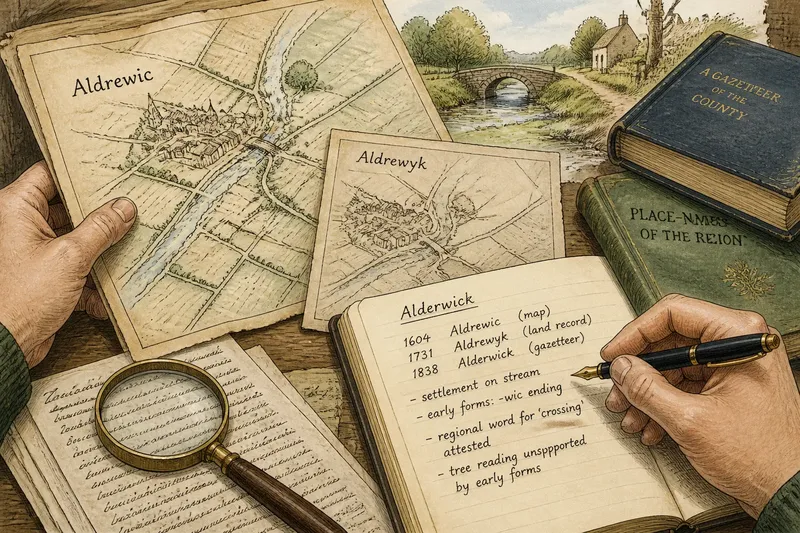
Imagine a fictional settlement called Alderwick. Suppose its current pronunciation sounds like “alder,” and you have an early map labeled “Aldrewic” and a later land record that uses “Aldrewyk.” You note the dates, confirm that both labels refer to the settlement rather than a nearby stream, and consult a reputable regional place-name reference. If that reference connects the older form to a local word for a crossing, while the records show a stream beside the settlement, you would describe the crossing interpretation as a supported possibility and keep the tree reading open only if further evidence supports it. The result is a reasoned account with a stated basis, not a definitive translation.
What should you check before choosing an interpretation?
- Pronunciation: If local speakers give a form that differs from the spelling, record both; if the difference is unclear, ask more than one speaker or mark it as unresolved.
- Record dates: If several dated forms show a consistent change, trace that sequence; if the dates or sources are uncertain, avoid claiming a precise path of development.
- Named feature: If records attach the name to the same feature, assess meanings for that feature; if the name shifts from a stream to a settlement, investigate the earlier referent separately.
- Language fit: If a proposed source matches a language documented in the area and fits the recorded sounds, keep it under consideration; if it depends only on a modern English resemblance, set it aside as unsupported.
- Landscape fit: If the proposed meaning describes a feature documented for the relevant period, treat that as supporting context; if the feature is absent or appeared later, look for another explanation.
- Source independence: If maps and records provide separate evidence, compare their details; if one simply repeats another, count them as a single evidential line and seek a different source.
Which questions help clarify a place name?
Can a place name preserve a word no one uses now?
Yes. Names can outlast the everyday vocabulary that formed them, especially when local speech changes. Older records and the area’s language history can help assess whether that is plausible.
Do old spellings reveal a name’s original meaning?
They may show how a name changed and expose forms obscured by modern spelling. A spelling alone does not prove which word was intended or which feature it named.
Can the landscape tell you what a place name means?
It can support or challenge an interpretation, but it cannot settle the origin by itself. The name may have shifted between features, or the relevant landscape may have changed.
Where can you look for place-name records?
Try historical maps, local archives, land or parish records, gazetteers, and reputable place-name references. Note whether each source gives original evidence or repeats an existing explanation.
How should you write about an uncertain origin?
Choose wording that reflects the strength of the record: “may derive from” marks a proposal, while “the earliest recorded form suggests” points to specific evidence. If credible sources disagree, describe the competing readings and what each rests on.
What a place name can preserve is sometimes only a partial trace: an older sound, a description, or a word once used for a nearby feature. The useful next move is to keep a clear record of the forms and sources you can verify; that makes later corrections possible without making the name claim more than the evidence allows.