Limestone or Brick: Reading a Building's Local Materials
Limestone or brick clues help you describe a building’s local character accurately, distinguish visible features from origin claims, and know when records matter.
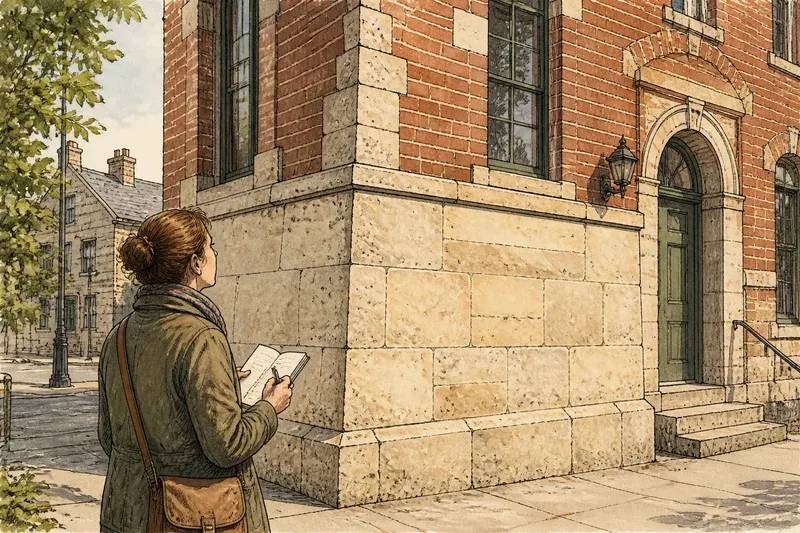
Limestone or brick clues can tell you how a building is put together before they tell you where its materials came from. A pale wall of broad blocks catches light differently from red brick laid in regular courses, but neither appearance identifies a quarry or kiln.
Start with what the facade actually shows: surface, unit shape, joints, and placement. Then decide whether a careful description is enough or whether the claim you want to make calls for documentary evidence.
What can you describe from the street?
Without plans, records, or permission to inspect a building closely, describe visible features rather than assign a source. “Pale stone blocks with broad joints” is more defensible than “local limestone.” “Red brick laid in regular courses” identifies a pattern without claiming where the clay was dug or the bricks fired.
Limestone may show a granular or subtly layered face, with small cavities or fossil-like marks on some stones. Brick usually repeats a rectangular unit, though tones and textures can vary from one brick to another. Paint, weathering, repairs, and manufacturing choices can blur these distinctions, so qualify an identification when the face is unclear.
For a travel note, record color in the current light, texture, unit shape, joint width, and where each material appears. These details remain useful even if later records change your interpretation.
Why look at surface and joints rather than color alone?
Color shifts with light, dampness, soot, and coatings. Limestone can appear cream, gray, buff, or yellow; brick may range from muted red to brown, purple, or pale tones. A painted wall may conceal the original face, while a repair can stand out even when it uses a similar material.
Look at how the surface catches light. Cut limestone may have crisp edges and an even plane; rough-dressed stone can retain tool marks or a broken texture. Brick faces may be smooth, sand-textured, or varied by firing. These are tendencies, not rules: both stone and brick can be finished in many ways.
Joints and arrangement add useful detail. Large ashlar blocks, irregular rubble, and stonework limited to door surrounds create different patterns. Brick courses, bond patterns, arches, and decorative headers shape a facade’s rhythm. Mortar outlines the units, but repointing can make the joints newer or more conspicuous than the material around them.
Where materials meet, record the transition before interpreting it. A stone base beneath a brick wall might reflect a practical choice, decoration, an addition, or a repair. One building can combine materials from different periods; location on the facade is a clue to construction history, not proof of a source.
Which clues fit your situation?
What should I record on a brief walk?
Note the apparent material, visible surface, color in the current light, unit shape, and joint pattern. If the face is visible but unconfirmed, write “appears to be limestone” rather than naming a source.
What if the wall is painted or heavily weathered?
Record what remains visible, such as coursing, block outlines, or brick joints, and leave the underlying material uncertain. If the coating hides the face, do not infer stone type from color alone.
How can I compare two nearby buildings?
Compare like features on both: unit size, finish, course alignment, and the framing around openings. Similar appearances can point to shared building practices, but they do not establish a shared quarry or brickworks.
What records can support a local-origin claim?
Check building records, conservation documentation, quarry or brickworks histories, and reliable local archives. A record that names a material or supplier supports an origin claim more directly than visual resemblance does.
When is closer research worth the effort?
Closer research makes sense when material origin matters to a restoration decision, a historical account, or a claim about regional identity. Begin with the building’s own records, if available, then compare them with conservation notes and local archival material. If the evidence names a stone type, supplier, or brickworks, you can distinguish documented provenance from an informed visual description.
Say you are writing about an invented town hall with a pale base and red upper facade. Your starting observations are large, lightly textured blocks below and repeated brick courses above. You write those features down, then check an invented municipal conservation file that identifies the base stone as imported and names no source for the brick. The resulting description can say the stone is documented as imported, while the brick’s origin remains unknown; the building’s local character rests in its composition and setting, not in an unsupported claim that every material came from nearby.
For a casual visit, archival digging is not worth the effort if all you need is a sound visual description. A few accurate observations serve better than an elaborate guess.
How should you record clues and decide what to claim?
- If the face is exposed and visibly granular or layered, describe those features and say “appears to be limestone”; if it is obscured, identify only the visible coating or pattern.
- If rectangular units repeat in courses, record brickwork and the course pattern; if the units are irregular or unclear, describe their shape without naming the material.
- If joints are broad, narrow, or visibly repointed, note that condition; if mortar obscures unit edges, avoid drawing conclusions from unit size.
- If stone appears only around openings or at the base, record its location; if the rest of the facade differs, describe the transition rather than assuming one construction phase.
- If two buildings share a surface and arrangement, note the resemblance; if you need to claim a shared source, seek records rather than relying on appearance.
- If a reliable building or conservation record names a material or supplier, attribute the origin claim to that record; if no record supports it, leave the source unresolved.
Keep observation and interpretation distinct. “The facade has pale rectangular blocks with fine joints” reports what is visible. “The blocks may be limestone, though the surface does not establish their source” makes the inference explicit.
Compare similar conditions where you can: a freshly cleaned stone wall and a soot-darkened brick wall may look more different than their materials warrant. Avoid scraping, probing, or removing coatings to satisfy curiosity. If an identification affects conservation work, consult a qualified preservation professional and follow applicable guidance.
Limestone or brick clues are most useful when they sharpen a description and point toward the right records. A building’s local character may come from its workmanship, arrangement, and setting even when its materials were brought from elsewhere.